Here at Prodek, our 30 years of industry experience are at the forefront of all of our practices; always striving to provide a thorough and professional service, and offering guidance and support wherever possible. Established in 1993, we are proud to be a full-service supplier, providing a fully comprehensive service from inspection to design, to manufacture, installation, and routine rack inspections. Experts in pallet racking systems, our expert site engineers are fully SIERS accredited (Storage Equipment Installers Registration Scheme), and host a wealth of expertise informed by their many years of direct industry experience.
As professional storage and space design experts operating across the UK, we understand more than most how important it is to you and your business to have an appropriate pallet racking system that suits the needs of your business; always taking into account the space provided to help deliver more revenue and productivity per square metre. Selecting an appropriate pallet racking system to suit your unique needs can be difficult. With Prodek’s comprehensive guide on pallet racking systems, selecting the right racking system for you and your needs has never been simpler.
What Is Double Deep Pallet Racking?

Perfect for storing high throughput, non-perishable goods, a double deep pallet racking system is a midway solution combining features of adjustable racking and high-density racking systems. Massively increasing storage capacity by storing pallets at two depths instead of one, double deep pallet racking is an extremely simple and effective way to store LIFO stock (last in, first out) for optimum accessibility.
Benefits Of Double Deep Pallet Racking Systems
- Fewer Aisles
- Increased Storage/Stock Holding Capacity
- Adaptable Treble & Quadruple Deep Pallet Configurations
- Simplified Pallet Rack Access
- Greater Cost Effectivity Per Square Metre
- LIFO Stock Rotation
What Is Narrow Aisle Pallet Racking?

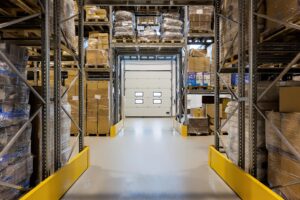
Excellent for warehouses with limited space, narrow aisle pallet racking systems are able to provide up to 50% more storage capacity when compared to standard pallet racking systems. With widths typically ranging between 1.8 metres and 2.3 metres, narrow aisle pallet racking offers greater storage capabilities for even the most minimal of warehouse spaces.
Benefits Of Narrow Aisle Pallet Racking Systems
- Unrestricted Access To Individual Pallets
- Optimised Storage Means For Greater Efficiency
- Reduced Stock Damage Rate
- Rapid Throughput Capabilities
- Increased Storage/Stock Holding Capacity
- Greater Cost Effectivity Per Square Metre
What Is Adjustable Pallet Racking?

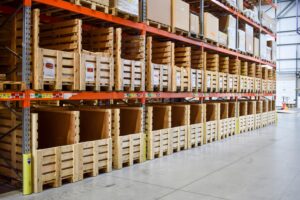
One of the more widely utilised storage systems found in warehouses, adjustable pallet racking is an excellent way to maximise your business’s revenue and allows for completely unrestricted access to pallets and stock utilising a counterbalance forklift truck. With a variety of standardised frame and beam size configurations, adjustable pallet racking systems can be designed to suit a range of warehouse requirements.
Benefits Of Narrow Aisle Pallet Racking Systems
- Quick & Simple Installation
- Standardised Equipment & Accessories Available
- Unrestricted Access
- High Throughput
- No Specialist Handling Equipment Required
- Increased Storage/Stock Holding Capacity
What Is Live Pallet Racking?

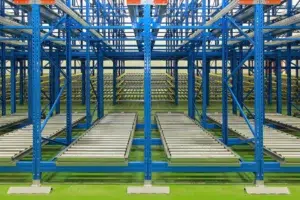
Commonly used to store perishable goods, live pallet racking is excellent for the rapid loading and unloading of pallets. Also sometimes referred to as ‘gravity flow racking’, live pallet racking operates by storing pallets in lanes of inclined gravity rollers; allowing stock to roll forward on automatic rotation. Available in both FIFO (first in, first out) and LIFO (last in, first out) configurations, live pallet racking offers maximum capacity, as only one aisle is required for forklift access.
Benefits Of Live Pallet Racking
- Fewer Aisles Required
- Rapid Stock Retrieval & Handling
- Automated Stock Rotation
- Fitted With Additional Safety Features i.e. Roller Brakes
- Accessible With a Standard Counterbalance Forklift
- Lower Handling Risks
- LIFO & FIFO Configurations
What Is Drive In Pallet Racking?

A high-density storage system, drive in pallet racking excellent for maximising limited warehouse space, whilst simultaneously streamlining the pallet handling and rotation process. Available in two different configurations, LIFO and FIFO, this stock management system makes it simple to achieve throughput and rotation requirements. LIFO offers efficient racking for storing perishable and quickly rotating goods; FIFO offers a rapid solution for storing and managing large amount off pallets.
Benefits Of Drive In Pallet Racking
- Efficient & Simple Access To Stock
- Standardised Add-Ons & Accessories Available
- Optimised Storage For Greater Efficiency
- Improved Stock Rotation
- LIFO & FIFO Configurations
Still Need Some Guidance? Contact The Prodek Team Today
Our team of storage and space design experts are always happy to lend a helping hand. Get in touch today to see how we can help.