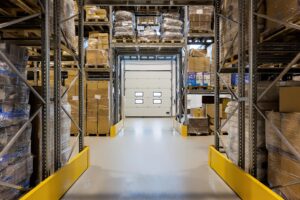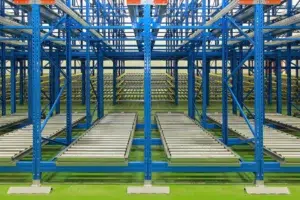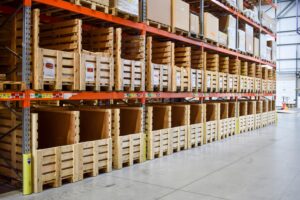
VNA racking, also known as very narrow aisle racking, is designed to totally maximise warehouse storage capacity. VNA racking is a high capacity storage system that provides unrestricted access to pallets. In warehousing, every square metre of space must deliver the greatest possible profit. One of the best ways to achieve this, is to fully utilise every cubic metre of space. This means combining narrow aisles with maximum racking height.
Very Narrow Aisle Racking (VNA) is the ultimate pallet racking type for space utilisation, and is slightly different to Narrow Aisle Racking (NAR). Narrow aisle means that more pallets can be stored in a given area than standard pallet racking. Very narrow aisle takes that further still. Take a look at typical pallet racking aisle widths below.

Standard or wide aisle pallet racking:
• Aisle width – 3.5 to 4 meters
• FLT – Counterbalance truck
• Can be as narrow as 2.5 metres for access via reach truck
Narrow aisle pallet racking:
• Aisle width – 1.8 to 2.3 metres
• FLT – Specialist narrow aisle truck
VNA racking:
• Aisle width – 1.5 to 1.6 metres
• FLT – Rail- or wire-guided VNA truck

Why Use VNA Racking?
In a nutshell, VNA racking delivers 55% space utilisation. This means that 55% of your warehouse space is dedicated to storage, with the remaining 45% dedicated to aisle space for forklifts to handle stock. By comparison standard, or wide aisle pallet racking, delivers 40% space utilisation with narrow aisle pallet racking delivering 50% space utilisation.
Space utilisation gains of 5% might seem trivial. However, do your sums and you will see that 5% more pallet space adds up to a tidy revenue increase. For large-scale warehousing operations, this is a significant increase.
VNA Racking Pros and Cons
You may be wondering why every warehouse isn’t using VNA racking. The primary consideration here is handling equipment. The world of forklift trucks has grown ever more complex as the warehousing sector itself continues to experience increased demand and the challenges that go with it. Global supply chains and the eCommerce boom mean that pallet storage and handling strategies vary depending on product type and available handling equipment. For instance, palletised perishable goods are usually best handled via a live pallet storage system, known as FIFO and LIFO.
Making the move to very narrow aisle pallet racking requires a change to handing equipment. Very Narrow Aisle Racking does not provide space for FLTs to turn. Therefore, a wire- or rail-guided forklift system is essential to VNA racking. Decision makers must weigh up the cost implications when considering a VNA racking installation. Fortunately in the majority of cases, the long term revenue increase outweighs the initial outlay of new racking and handling equipment. It can make the difference between a disruptive premises move and being able to extract more from existing premises. Moreover, an improved logistics service is good for customer retention.
The added benefit of VNA racking is its tendency to inflict less damage to pallets during handling. VNA trucks generally move a little slower than a standard counterbalance truck but being a guided handling system means it is more accurate and less susceptible to human error. VNA trucks reach a lot higher than standard FLTs so support full utilisation of vertical storage capacity.

I’m Interested. How Does it Work?
If you are ready to weigh up the pros, cons, and cost implications of VNA racking for yourself, the best place to start is to book a site audit. Have an idea of what you want to achieve in the short and long term and let your racking supplier’s engineers get to work.
When it comes to the choice of supplier, experience goes a long way. A seasoned racking engineer will be able to highlight all the pinch points where bottlenecks or safety issues could occur. They will also identify opportunities to extract maximum storage capacity from your premises. Make sure your chosen VNA racking supplier offers the below services:
- End-to-end project management
- Site survey
- Design
- Building regulations application (where required)
- Design
- Manufacture
- Installation
- Annual racking inspections.
Book your site survey with Prodek. We provide a complete, end-to-end VRA racking design, manufacture, and installation service. Rail- or-wire guidance systems, with a comprehensive range of racking accessories are available. Our storage systems don’t just stop at pallet racking. We provide a full warehouse fit out service, from offices to mezzanines, with M&E, plumbing, heating, and décor, to complete the job.