
Optimising warehouse space is crucial for ensuring operational efficiency, enhanced safety and retaining value out of every square metre of your premises. When integrating racking systems and walkways on your site, calculating the space required for safe manoeuvrability between aisles is important to improve productivity and maximise storage capacity. Within this guide, you will develop a greater understanding of what aisle width you require for optimised layouts and forklift types.

Why Do We Need to Calculate Aisle Widths?
Selecting the right aisle width affects several aspects of warehouse operations and is essential in maintaining compliance with UK regulatory standards. The key reasons for aisle considerations include:
Operational Efficiency
Ensuring adequate aisle widths contributes to ease of manoeuvrability, reducing time wasted trying to navigate complex spaces.
Space Utilisation
Different racking systems require certain aisle widths, so it’s important to understand whether a business needs specialised forklifts when integrating units such as very narrow aisle racking (VNA).
Layout Optimisation
Understanding aisle widths for premises ensures warehouse racking layouts can be optimised and utilised to their full potential.
Safety
Insufficient space can lead to accidents, including damage to inventory and the forklifts themselves.
Compliance
Warehouses must adhere to safety regulations, resulting in racking systems having a minimum set width that must be met.

What Can Affect Aisle Width?
The Forklift Type
Different forklift trucks will have their own specifications, including their turning radius and how they are handled. Generally, forklifts found commonly in warehousing will include:
Counterbalance Forklifts – These are standard forklift trucks found in the vast majority of warehouses and shipping yards, which can accommodate wider aisle widths.
Reach Trucks – Smaller than a standard counterbalance truck, reach trucks can handle narrower aisles and smaller premises.
VNA (Very Narrow Aisle) Trucks – These forklifts can operate in extremely tight spaces with guided rail systems for additional safety and support.
Forklift trucks will typically come with a manufacturer’s minimum aisle width requirement, along with recommendations by racking manufacturers and HSE guidelines.
Load Dimensions
The size of the loads being transported across the warehouse is also an important consideration as it will affect the weight shift as the forklift turns and offloads goods.
Pallet Size – The size of the pallet will contribute to weight distribution. The most notable sizes in the UK are the Euro pallet, 1200mm x 800mm and the UK standard pallet, 1200mm x 1000mm.
Load Overhang – The pallet or load itself may overhang on the arms of the forklift, which will require additional space when in operation.
Load Height – Tall loads will require further stability and careful handling.
Turning Radius and Length
Each type of forklift will have a specified turning radius, this dictates the space required to complete a 90-degree turn.
Right Angle Stack (RAS) Distance – This determines the minimum aisle width needed for the forklift to raise and lower pallets.
Forklift Length – This is measured from the back of the counterweight to the front of the load wheels.
Additionally, there are extra clearance requirements when operating forklifts, which include:
Operator Safety – Recommended at 300mm to 500mm on either side.
Pedestrian Footpaths – Extra space must be made for pedestrians if they work alongside forklift trucks.
How to Calculate Aisle Width for Forklifts
In order to obtain the correct forklift aisle width, several steps must be undertaken.
Step 1: Obtain essential forklift measurements from the manufacturer.
- Forklift Length (FL)
- Right Angle Stack (RAS) Distance
- Pallet Size (P) and overhang
Step 2: Use the standard formula to calculate the forklift aisle width.
Minimum Aisle Width = Forklift Clearance + Load Width + Pallet Depth
It’s also usual to include 200mm to 300mm clearance for additional accuracy.

Standard Racking Aisle Widths
Wide Aisle Racking: Typically requires an aisle width of 3m to 3.5m, suitable for counterbalance forklift trucks.
Narrow Aisle Racking: Usually with widths between 1.8m to 2.4m, ideal for reach trucks.
Very Narrow Aisle Racking: Aisles can be as tight as 1.2m to 1.5m, used with VNA forklifts and guided rails.
How to Maximise Space Efficiency
When handling limited warehouse space, it’s essential to consider all options before deciding to move to another unit, which can be costly and cause a halt in processes. By establishing a warehouse layout plan and investing in the right equipment for your space, it can be possible to achieve up to 50% increased storage capacity. This is demonstrated with VNA racking units compared to traditional wider racks.
Additionally, a reputable racking manufacturer and inspections can assess your site to determine the most optimal layout requirements that reduce bottlenecks and optimise traffic flow.
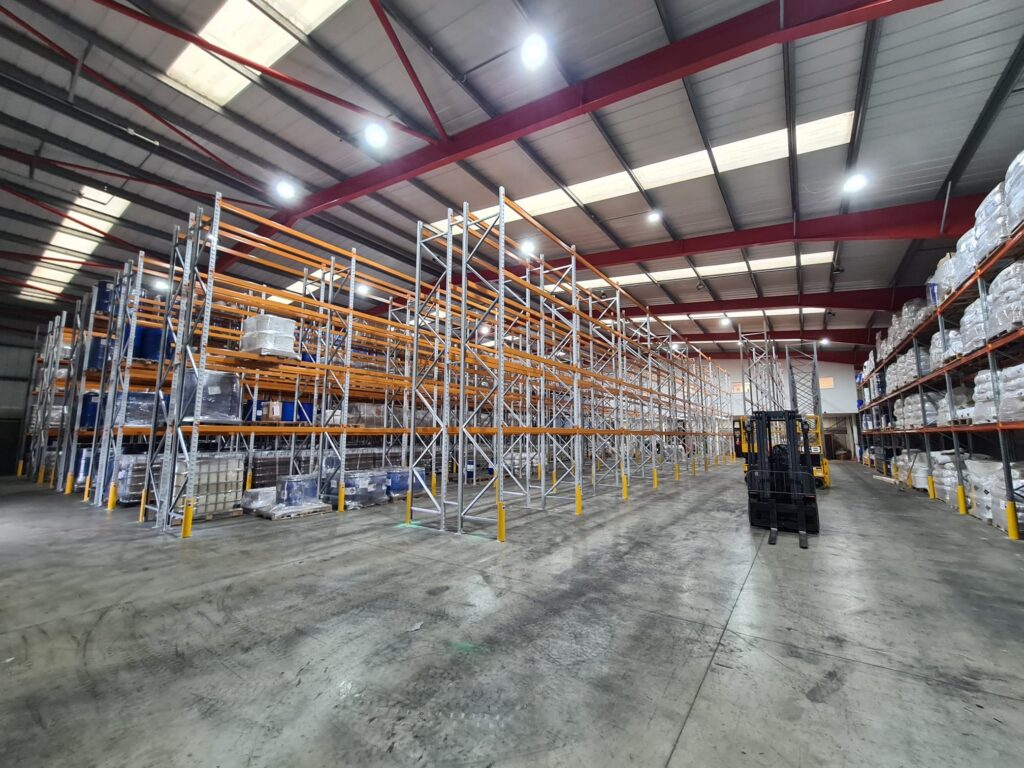
Discover Prodek’s Full-Service Racking Solutions
Maintaining the correct aisle width not only encourages health and safety in the workplace but also allows your business to make decisions that optimise the existing premises. At Prodek, we provide comprehensive services that encompass site surveys, installation and annual racking inspections so that you remain compliant and avoid costly penalties.
For further information and guidance regarding racking aisle widths or layouts for your business, enquire today with a member of our team for thorough and professional advice.